
Signs of Quality Custom Cabinetry: A How-To Guide
Table of Contents
What Defines Quality Custom Cabinetry?
Custom Kitchen Cabinet Construction Standards to CheckAll-Plywood Boxes vs. Particle BoardThe Knock-Down vs. Factory-Assembled DebateDovetail Drawers and Full-Extension SlidesDrawer Slide Mounting: Undermount vs. Side-MountFull-Height Back Panels and Box Assembly
All-Plywood Boxes vs. Particle Board
The Knock-Down vs. Factory-Assembled Debate
Dovetail Drawers and Full-Extension Slides
Drawer Slide Mounting: Undermount vs. Side-Mount
Full-Height Back Panels and Box Assembly
Hardware and Hinges: The Moving Parts
The Custom Cabinetry Design Process: From Concept to Build
Custom Millwork for Odd Spaces: A True Test of Skill
Your Visual Inspection ChecklistThe Showroom Field TestLong-Term Maintenance and RepairabilityEnvironmental and VOC Standards Worth Asking About
The Showroom Field Test
Long-Term Maintenance and Repairability
Environmental and VOC Standards Worth Asking About
Conclusion: Making Your Choice with Confidence
Frequently Asked Questions
What Defines Quality Custom Cabinetry? A Builder's Guide to What Actually Matters
Last Updated: September 9, 2026
Quality custom cabinetry is defined by the materials you cannot see as much as the finish you can, and recognizing the signs of quality custom cabinetry before you commit to a builder saves you from costly repairs down the road. At haileyinc, we have built and refaced kitchens across the Guelph area since 2005, and we have seen what separates cabinetry that lasts thirty years from boxes that fail in five. This guide shows you what to inspect, what questions to ask, and how our free estimates and 3D design process help you evaluate options before any commitment.
What Defines Quality Custom Cabinetry?
Quality custom cabinetry is built to fit your specific space and lifestyle using structural materials designed for decades of daily use, rather than mass-produced boxes sized for standard layouts. True custom work is measured by its construction standards, not just its appearance. Two kitchens can look identical in a photograph; only one will still function flawlessly after fifteen years of heavy use.
The real test of quality lies in the cabinet box, the drawers, the hinges, and the joinery, the components that determine structural integrity and exactly what most homeowners never think to inspect.
Custom Kitchen Cabinet Construction Standards to Check
The construction standards of your cabinet boxes and drawers determine whether your investment holds up. Custom kitchen cabinet construction standards vary widely between shops, and knowing the difference between premium methods and shortcuts is the most valuable skill you can bring to a renovation.
All-Plywood Boxes vs. Particle Board
The cabinet box is the structural skeleton of your kitchen. All-plywood construction uses layers of wood veneer bonded together, creating a panel that resists moisture, holds screws firmly, and maintains its shape over decades. Particle board and MDF are compressed wood fibers that swell when exposed to moisture and strip easily when hardware is adjusted.
A simple field test: check the edges of the cabinet box where panels meet. Plywood shows a distinct layered edge, while particle board looks uniform and granular. Plywood also resists the sagging that plagues wide upper cabinets holding heavy dishware. If a builder cannot tell you what material forms their boxes, that answer itself tells you everything.
The Knock-Down vs. Factory-Assembled Debate
A question few buyers think to ask is whether your cabinets will arrive fully assembled or as flat-packed "knock-down" kits. Factory-assembled boxes are glued and clamped under pressure, creating a rigid, monolithic structure. Knock-down cabinets rely on cam locks and metal connectors that can loosen over years of use.
While some high-end European manufacturers produce excellent knock-down systems, a glued and doweled box assembled in a controlled shop environment will typically resist racking and twisting better than a field-assembled one. When comparing quotes, ask whether the price includes factory assembly.
Dovetail Drawers and Full-Extension Slides
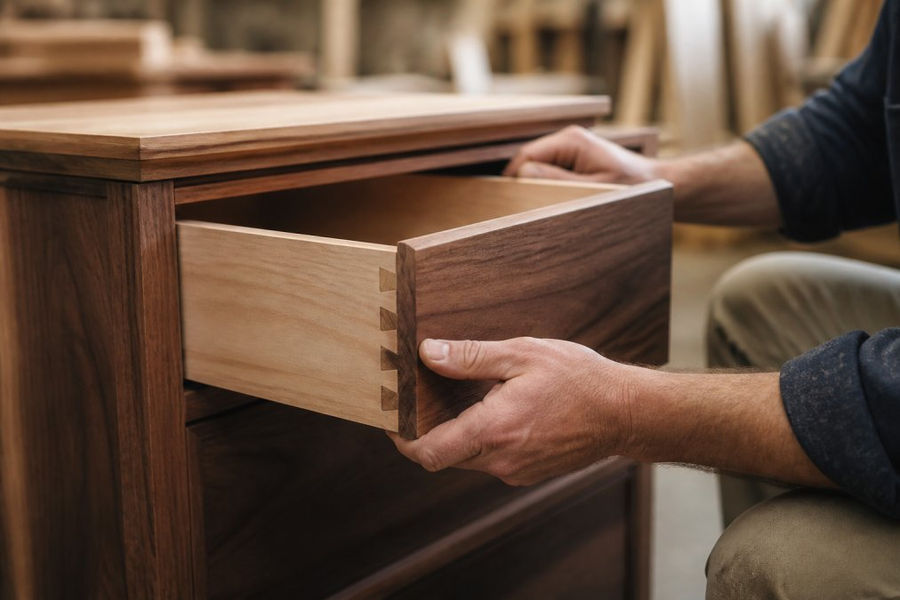
Dovetail drawers are the gold standard of drawer box construction. The interlocking joints physically lock the drawer sides together, creating a box that will not pull apart at the corners no matter how much weight it carries. Cheaper alternatives rely on staples or butt joints that loosen over time.
The drawer slides matter just as much as the joints. Full-extension slides let the drawer pull completely out, giving you access to every item in the back. Undermount slides are quieter, smoother, and support more weight than side-mounted versions. Open every drawer in a showroom and feel the difference: quality slides glide with a solid, controlled motion, while cheaper ones wobble and rattle.
Drawer Slide Mounting: Undermount vs. Side-Mount
Side-mount slides attach to the sides of the drawer box and the cabinet opening. They are simpler to install and adjust, but they narrow the usable interior width of the drawer and are visible when the drawer is open. Undermount slides attach beneath the drawer box, hiding the mechanism entirely and allowing the drawer to sit flush with the cabinet face. They also provide a smoother, quieter action and typically support heavier loads.
A critical detail to check is the weight rating of the slides. Quality undermount slides are typically rated for 75 to 100 pounds or more, while budget side-mount versions may only handle 50 pounds (blum.com). Ask your builder for the specific brand and model of slide they use, and look up the manufacturer's weight rating yourself.
Full-Height Back Panels and Box Assembly
A detail that separates premium cabinetry from production work is the back panel. Many manufacturers use a thin sheet of hardboard or Masonite nailed into a groove, which does little to prevent the box from racking out of square. Quality custom cabinets use a full-height back panel made of the same plywood as the box, screwed and glued into place, acting as a shear wall that keeps the cabinet square and rigid.
Also examine how the cabinet box is assembled at the corners. The strongest method uses dowels or confirmat screws combined with waterproof glue, creating a joint stronger than the wood itself. Cheaper boxes may rely on staples or minimal glue, which fail when stressed. Run your hand along the inside corners; you should feel smooth, tight joints with no gaps or visible fastener heads.
Key Takeaway Plywood boxes with dovetailed drawers and full-extension undermount slides are the non-negotiable foundation of cabinetry built to last. If these are present, the rest of the build usually follows the same standard.
Hardware and Hinges: The Moving Parts
Hinges and drawer slides take the most abuse of any component in your kitchen, enduring thousands of open-and-close cycles every year. Quality custom cabinetry uses soft-close hinges and glides as standard equipment, not as an expensive upgrade. Soft-close mechanisms use hydraulic dampers to prevent slamming, protecting both the hardware and the cabinet box from impact damage (hettich.com).
Face frame and frameless cabinetry each use different hinge systems, and both can be excellent when executed properly. What matters is that the hinges are adjustable and carry a finish that will not corrode in a humid kitchen environment. Ask your builder which hinge brand they install and why; a confident, specific answer signals a shop that has tested its components.
The Custom Cabinetry Design Process: From Concept to Build
A genuine custom cabinetry design process begins with measuring your actual space and understanding how you cook, store, and live, not with selecting a catalog model. The best renovations start with a detailed consultation about your storage needs, appliance sizes, and household traffic patterns.
Most reputable shops now offer 3D design renderings that let you see your kitchen before a single panel is cut, catching layout problems early. At haileyinc, we provide free estimates and full 3D design as part of our process, so you can evaluate the layout, the materials, and the budget before work begins.
The design phase is also where you should discuss door styles, wood species, grain matching, and finish options. A skilled designer will explain how your choices affect durability, not just appearance.
Custom Millwork for Odd Spaces: A True Test of Skill
Custom millwork for odd spaces is where mass-produced cabinetry fails and true craftsmanship earns its keep. Basements with low ceilings, kitchens with angled walls, built-in units around fireplaces, and alcoves under stairs all demand pieces that are measured, cut, and fitted on site. A cabinet maker who executes these transitions seamlessly demonstrates skill that standard boxes cannot match.
When evaluating a builder for an awkward space, ask to see photographs of similar past projects. Look at how the millwork meets the wall and handles an uneven floor. The quality of the fit and finish in these challenging areas tells you more about a shop's capability than any showroom display.
Your Visual Inspection Checklist
Use this checklist when you visit a showroom or when your own cabinets arrive. Each item takes seconds to check and reveals the true standard of the build. Save it to your phone before you walk into a showroom; it will keep you focused on structure rather than styling.
What to Inspect | What Quality Looks Like | What Signals Trouble |
Cabinet box edges | Visible layered plywood edge | Uniform, granular particle board |
Drawer corners | Interlocking dovetail joints | Stapled or glued butt joints |
Drawer slides | Full-extension, undermount, soft-close | Side-mounted, partial extension |
Hinges | Soft-close with adjustment screws | No dampening, fixed position |
Back panels | Full-height, screwed into the box | Thin hardboard nailed in place |
Door finish | Even stain, smooth top coat, consistent grain | Runs, drips, or mismatched panels |
Beyond the structural checks, run your hand along every exposed edge. Quality cabinetry has smooth edge banding on all visible panels, not just the front. Open and close every door and drawer several times, listening for smooth operation and solid sounds. Check that the finish is consistent across all visible surfaces.
The Showroom Field Test
A showroom visit is your best opportunity to evaluate a builder's work, but only if you know how to test it. Start by opening every single drawer and door in the display kitchen, not just the ones at eye level. Push down on the bottom of an open drawer; quality boxes will not flex or creak. Close a drawer with moderate force; a quality soft-close mechanism will catch and glide it shut gently.
Next, look inside a base cabinet and check whether the back panel is full-height and screwed in place. Check the corners for glue squeeze-out, which indicates a properly clamped joint. Ask the salesperson to remove a drawer so you can see the slide mechanism and drawer box construction. A reputable shop will happily do this; one that hesitates may have something to hide.
Long-Term Maintenance and Repairability
Quality cabinetry is not just about how it looks on day one; it is about how easily it can be maintained and repaired over a decade or more of daily use. A quality finish can be touched up or re-coated by a professional, while a cheap factory finish may require a full door replacement if scratched.
Soft-close hinges and slides are mechanical devices that will eventually wear out. Quality brands like Blum and Hettich manufacture replacement parts that are widely available, meaning a single hinge can be swapped out in minutes. Ask your builder which brands they use and confirm that replacement parts will be available for the life of your cabinets.
Environmental and VOC Standards Worth Asking About
A growing concern for many homeowners is the environmental and health impact of their cabinetry. The glues and finishes used in cabinet construction can off-gas volatile organic compounds (VOCs) into your home for months after installation. Quality custom shops are increasingly using low-VOC finishes and formaldehyde-free adhesives.
When comparing builders, ask whether their plywood is CARB2-compliant, a standard that limits formaldehyde emissions from composite wood products (arb.ca.gov). Also ask about the finish; a high-quality conversion varnish or catalyzed lacquer is more durable and emits fewer VOCs once cured. A builder who speaks knowledgeably about these standards demonstrates care beyond the visible surface.
Watch Out Do not let beautiful door fronts distract you from the box behind them. Many manufacturers install premium doors on particle board boxes, knowing that most buyers never open a drawer to check the joinery. The doors are the easiest part to replace; the box is what you live with for decades.
Conclusion: Making Your Choice with Confidence
Choosing quality custom cabinetry comes down to asking the right questions and knowing what the answers mean. You now have the tools to inspect construction standards, evaluate hardware, and recognize the skill required for custom millwork in difficult spaces. The best way to see these standards in action is to visit a shop, open the drawers, and ask about their process directly.
At haileyinc, we have served the Guelph area since 2005 with cabinetry built from premium materials and backed by an eight-time Reader's Choice Diamond award. Our free estimates and 3D design process let you see exactly what your space could become before you commit. Book online today and bring your renovation questions to a team that treats every project as a reflection of our own name.
Frequently Asked Questions
What is considered a high grade cabinet?
A high-grade cabinet is defined by its construction standards, not just its look. Look for all-plywood boxes, dovetail drawer joints, full-extension undermount glides, and soft-close hinges. Solid wood or quality veneer doors with proper edge banding and a durable top coat also signal higher quality. These elements ensure the cabinet remains square and functional for decades, unlike lower-grade options that use particle board and stapled joints which can fail over time.
How do I distinguish between custom cabinetry and mass-produced alternatives?
The main difference lies in the design process and construction. Mass-produced cabinets are built to standard sizes in a factory with limited options. Custom cabinetry is built to your exact specifications, allowing for custom millwork for odd spaces and unique design preferences. You'll notice quality in details like full-height back panels, precise grain matching, and the ability to modify internal layouts. A true custom shop will offer a design process that starts with your needs, not a catalog.
What are the key indicators of high-quality cabinet construction?
Focus on the cabinet box and drawers. Check that the box is made from plywood rather than particle board or MDF. Drawer boxes should feature dovetail joints and sit on full-extension, soft-close undermount glides. Hinges should also be soft-close. Look for a full-height back panel, which adds structural integrity. These elements are the backbone of durability and are the clearest indicators of quality.
How does the design phase affect the final quality of custom cabinets?
A thorough custom cabinetry design process prevents errors and maximizes your space's potential. It should include a site visit to measure for odd angles and low ceilings, material selection, and detailed drawings. This planning catches issues before they become costly problems. It also allows for custom millwork for odd spaces, ensuring every inch is used effectively. A professional will provide a 3D design so you can visualize the result before the build begins.
Book Online



Comments